
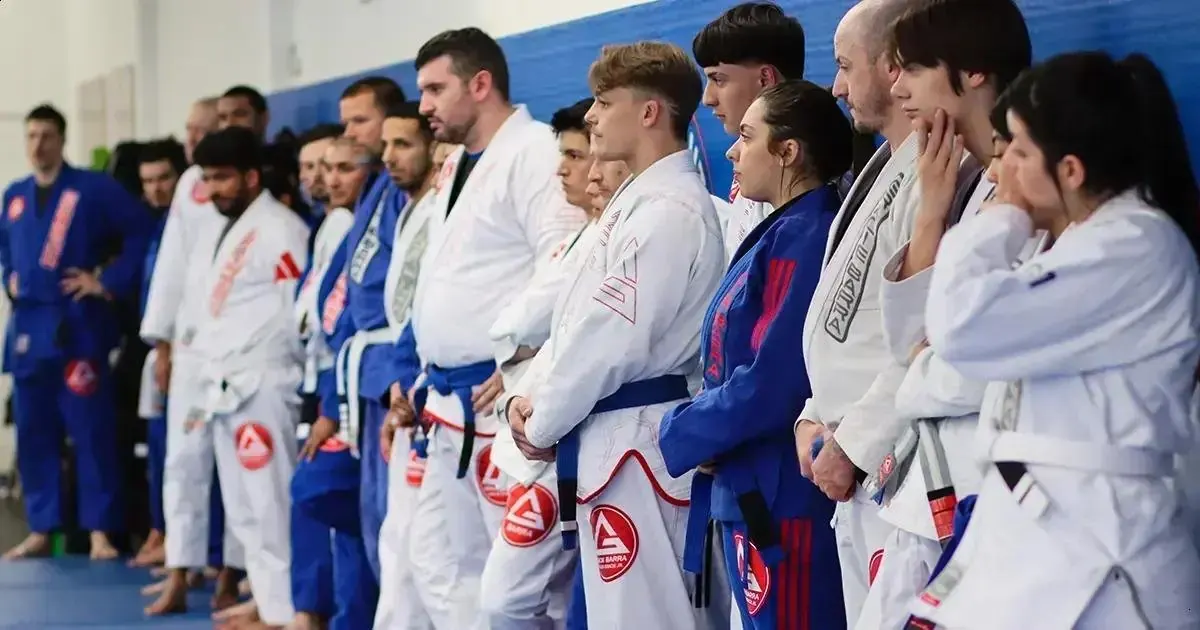
In Brazilian Jiu-Jitsu, an adult beginner normally starts at white belt. The familiar adult sequence is white → blue → purple → brown → black. Children use a different youth progression system, so the adult colors should not be treated as a complete explanation of kids' ranks.
What belts do—and do not—tell you
- A belt shows a stage of development. It is not a substitute for safe technique or training habits.
- Progress is individual. Attendance alone does not guarantee a promotion.
- Beginners can measure improvement now: knowing positions, controlling movement, escaping carefully and communicating with partners.
What each adult belt generally represents
White belt: learn the language of the mat
Focus on identifying guard, mount, side control and back control; practicing base movements; and understanding when to tap. You do not need to know submissions before your first class.
Blue belt: connect the fundamentals
With experience, students begin to recognize common patterns, defend more deliberately and link techniques together. There is no universal number of classes that guarantees reaching this level.
Purple and brown belts: refine decisions and timing
At later stages, technique typically becomes more adaptable to varied partners and situations. Students continue learning fundamentals rather than leaving them behind.
Black belt: expertise with continued learning
A black belt reflects extensive development and responsibility, not the end of practice. Individual eligibility and promotion decisions are made under the school and governing organization's standards.
Three ways to see progress before your next belt
- Position recognition: can you tell where you are and identify a sensible next step?
- Technical control: can you repeat a movement slowly, with balance and without forcing your partner?
- Training habits: do you tap when needed, take correction and return ready to practice again?
How beginners start at Gracie Barra Riverton
The published adult program begins at age 16 with GB1 Fundamentals. It introduces positions, movements, escapes and guided practice before students advance into more complex work. For children, the Kids program serves ages 3–9 and Juniors & Teens serves ages 10–15.
Gracie Barra Riverton lists its address as 2936 W 12600 S, Ste 1&2, Riverton, UT and offers a free first class. You can also review the timetable and pricing guide before committing.
Questions about belt progression
How many months does it take to reach blue belt?
There is no reliable universal timeline. Progress and promotion depend on instruction, proficiency, consistency and the school's standards.
Does a stripe mean I will be promoted next month?
No. Ask your instructor what a stripe means within the current curriculum rather than assuming a fixed schedule.
Can kids use the same belt chart as adults?
No. Youth rankings differ; ask the Kids or Juniors & Teens instructor to explain the program's progression.