
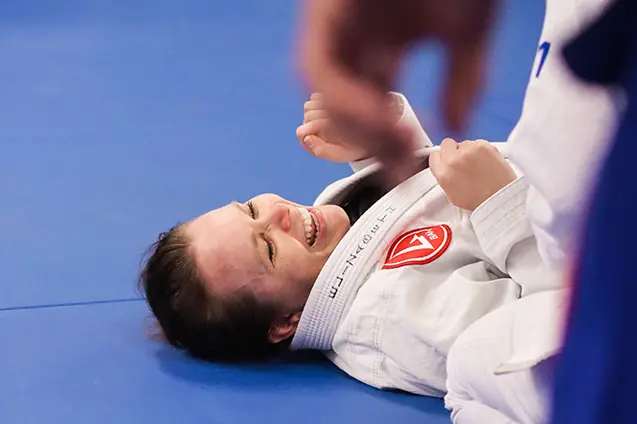
Brazilian Jiu-Jitsu (BJJ) and karate are both martial arts, but the emphasis differs. BJJ commonly teaches grappling, ground positions, escapes and submission-related control. Many karate schools teach striking, blocks, stances and forms, with significant variation between styles. Neither is the automatic best choice for every family.
Quick comparison
- BJJ: grappling, partner control, positioning and escapes.
- Karate: often striking, footwork and forms; details depend on the style.
- Both: can provide structured practice, coach feedback and movement.
- Best test: observe a class that matches your age, goals and comfort with contact.
What is the training difference?
In a BJJ fundamentals class, you may work on safe body movement, guard, mount, positional escapes and basic grappling concepts. Some partner contact is integral to training. In karate, the share of technical drilling, forms, striking practice and sparring depends heavily on the particular school. Ask for details rather than judging an entire style by a short video.
Which might suit a child?
Choose the individual program, not just the discipline. Look at coach supervision, group size, contact rules and whether the child enjoys participating. Gracie Barra Riverton publishes Kids BJJ for ages 3–9 and Juniors & Teens for ages 10–15. Ask what techniques are used for each age group and confirm that your child's needs can be accommodated.
Which might suit an adult beginner?
If you want to learn positional grappling with a structured introduction, BJJ may fit. If you prefer striking techniques or forms, you may want to visit karate schools too. At Riverton, people aged 16+ can begin in GB1 Fundamentals. The school does not advertise karate classes; this is a comparison to help you choose, not a promise of multiple disciplines at this location.
Does one offer better self-defense?
Real-world safety depends on far more than a training style. Situational awareness, avoiding escalation and seeking help should come first. Neither BJJ nor karate guarantees safety in a confrontation. Compare realistic coaching practices and how each gym talks about limits.
What about price and routine?
For a fair comparison, ask each school about tuition, billing frequency, uniforms, program length, class times and cancellation. Riverton's published BJJ memberships cost $52, $57 or $67 per week, billed every two weeks, with a separate uniform purchase. See Riverton's detailed pricing and the current timetable.
Questions to ask during a trial
- Which beginner movements and safety signals are taught first?
- How much supervised partner contact happens in this age group?
- Can students progress at an appropriate pace?
- Can we see the actual terms and total costs before enrolling?
Riverton offers a free first BJJ class, with a loaner gi offered for the visit. Comparing a real trial with other local options is more useful than a blanket claim that one martial art is superior.